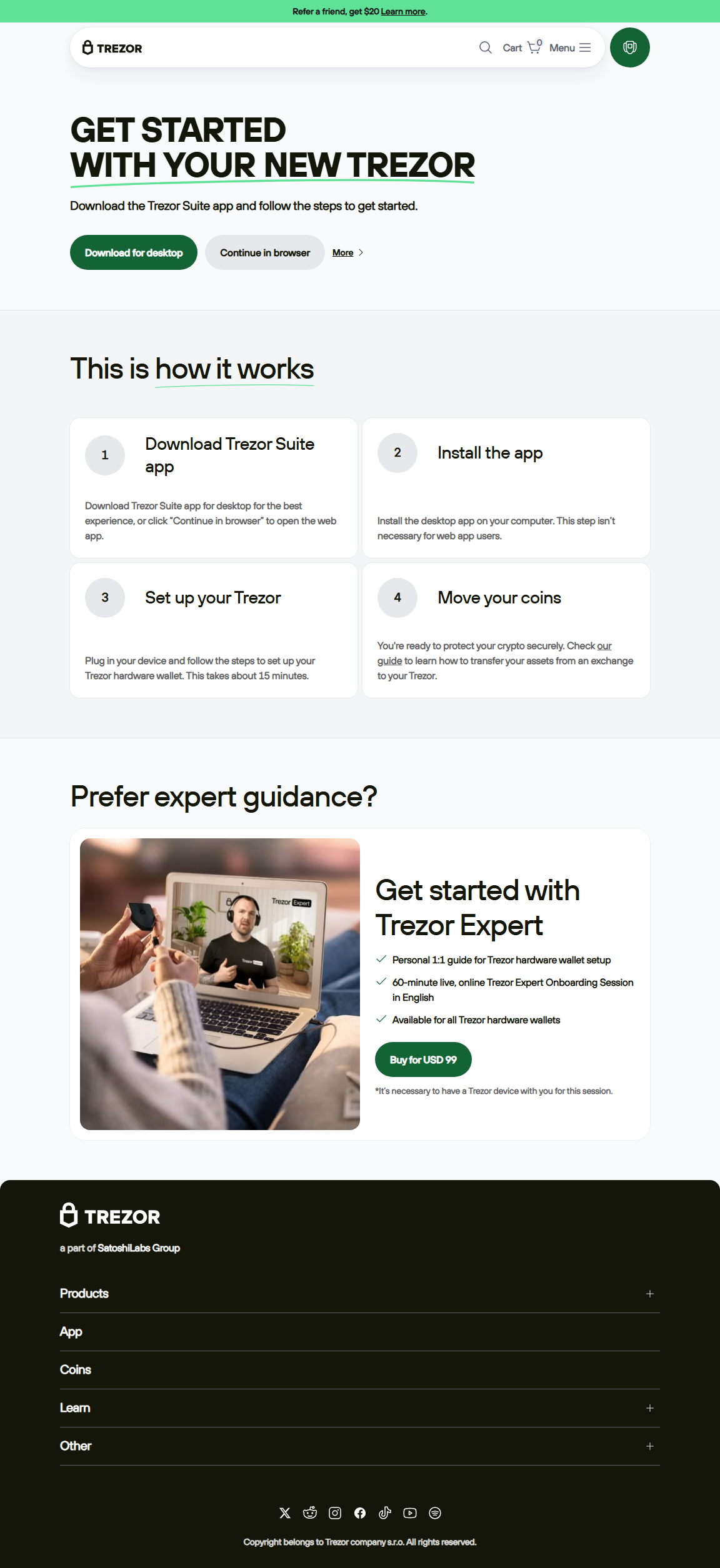
Trezor Login: A Complete Walkthrough for Secure Crypto Access
Master how to safely log into your Trezor hardware wallet, protect your digital assets, and understand the mechanics behind one of the most secure crypto authentication systems.
🔐 Introduction to Trezor Login
The Trezor login process is the backbone of crypto self-custody. Unlike online wallets or exchanges, Trezor doesn’t rely on traditional credentials — it uses your hardware device as the gateway to your funds. Every login requires a direct device confirmation, ensuring your private keys never leave your possession.
For beginners, understanding this system is crucial. Trezor removes the weakest link — centralized servers and passwords — replacing them with a secure, cryptographic handshake that takes place entirely within your device.
💡 What Makes It Secure?
Your Trezor device stores your private keys offline. Every time you log in, your device signs a digital challenge — not your computer. This cryptographic system prevents hackers from ever stealing your credentials, even on compromised networks.
🧠 Why It’s Different
Unlike password-based systems, Trezor login authenticates ownership by verifying your hardware signature. There’s no “login server” to hack and no account database to steal. Your device is the login key.
⚙️ Step-by-Step: How to Log In to Your Trezor Wallet
- Connect your Trezor device: Use the USB cable to connect it to your computer or mobile phone.
- Open Trezor Suite: Launch the official Trezor Suite app or visit suite.trezor.io.
- Verify the connection: Your computer will detect the device, prompting a login window.
- Enter your PIN: Use the randomized keypad shown on your Trezor screen to input your PIN safely.
- Optional: Enter your passphrase: If you use a passphrase wallet, input it carefully. Each unique phrase opens a different wallet.
- Access your dashboard: Once authenticated, your balances, transactions, and coins appear instantly in Trezor Suite.
🧬 The Technology Behind Trezor Login
At its core, Trezor uses public-key cryptography — a secure method where a public key verifies ownership of a private key. During login, your device signs a challenge message using your private key stored inside. The app verifies it using your public key, confirming your identity without ever revealing the private data.
This is why Trezor login is fundamentally safer than online authentication. It operates using zero-knowledge proof principles, where validation happens without exchanging secrets — a game-changing model for digital security.
📊 Trezor Login vs. Other Crypto Access Methods
| Feature | Trezor Login | Exchange Login | Software Wallet |
|---|---|---|---|
| Private Key Storage | Offline hardware | Centralized servers | Local but online |
| 2FA Security | Hardware confirmation | SMS / app-based | Optional |
| Open Source | ✅ Yes | ❌ No | Partial |
| Risk of Phishing | Extremely low | High | Moderate |
💬 Frequently Asked Questions
Q1: Can I log into Trezor from different devices?
Yes. You can access your wallet from any computer using your hardware device. Just ensure you use official Trezor software or verified URLs.
Q2: What if I forget my PIN?
You can reset the device, but you’ll need your recovery seed to restore funds. Without it, your assets cannot be recovered — it’s your ultimate backup.
Q3: Is Trezor Suite safer than using the web version?
Yes, the desktop Trezor Suite app reduces the risk of phishing attacks and doesn’t depend on a browser’s security environment.
Q4: What’s the difference between PIN and passphrase?
The PIN unlocks the device; the passphrase unlocks hidden wallets. Think of the PIN as your door key and the passphrase as a secret room key inside your house.
⚠️ Beware of Fake Trezor Login Pages
Always ensure you’re connecting through suite.trezor.io or the official Trezor desktop app. Never enter your recovery seed on a website — Trezor will never ask for it. Scammers use imitation pages to steal recovery phrases; double-check every URL and browser certificate before continuing.
🚀 Expert Tips for a Safer Trezor Login Experience
- Keep your firmware updated to patch vulnerabilities and add new coin support.
- Activate passphrase protection for hidden wallets.
- Use Trezor Suite’s Tor mode for privacy-conscious transactions.
- Confirm transaction details directly on your Trezor screen.
- Store your recovery seed on metal backups instead of paper for long-term durability.
🏁 Conclusion: Taking Control with Trezor Login
The Trezor login process isn’t just a way to access your wallet — it’s a statement of self-sovereignty. By using hardware authentication, open-source verification, and offline key storage, Trezor empowers you to truly own your crypto without relying on intermediaries.
As the crypto landscape evolves, protecting your digital wealth becomes a personal responsibility. With Trezor, that responsibility comes with simplicity, reliability, and confidence. Remember: every time you connect your Trezor, you’re choosing independence over dependence — a small action that defines the future of finance.